

There was once a kingdom in Lower Pomerania known as “Oddland.” If you happened to look at a map of this kingdom, the first thing you would have noticed was its odd shape. It wasn’t really a shape at all, at least, not one of the shapes that have any other name except odd. It wasn’t large and it wasn’t small. It wasn’t short and it wasn’t tall. This was the case for everything in Oddland. The shape of the roads were just as odd as the shape of the border and the shape of the houses along the roads were even odder. In fact, the capital of this kingdom was the oddest of all the oddities in Oddland. It was built into one of the oddly shaped mountains that formed its northern border. Yet it wasn’t built “into” so much as built “onto.” While most towns carve the terrain to accommodate their buildings, the Oddlandians had built their buildings to accommodate the shape of the mountain. The result was a city with all the buildings not pointing upwards but outwards so that it looked as if the mountain had risen up underneath an already built city like a berm underneath a patch of sod. It was a wonder of engineering that they managed to build such things, though why anyone should want to build them in such a way is the biggest wonder. The oddest part of Oddland was their King. This was in a time when despots were not as wicked as we think of them now. This King was a despot and belonging to a more innocent time, he used his despotism in the oddest way possible. It was the law of Oddland that when the king went away either to war, a diplomatic visit, or even something as simple as a hunting trip, the throne would be given to a member of the King’s palace, chosen at random, during the duration of the King’s absence. No member of the palace was excluded. From the lowest to the highest, any could be ruler for a time, no matter if they were an heir or not. Thus, whether man or woman, slave or free, any person employed by the King could be come the sovereign. In this way, the Oddlandians were more progressive than our modern progressives for they believed in equality before equity. Yet we must not interrupt our real history of Oddland to talk about fairy tales. To add to the oddity of this law, the citizens of Oddland held only one of two opinions about it: they were either indifferent to it or believed it to be the greatest law ever written. If a foreign revolutionary had marched into Oddland on a Saturday, deposed the despot, and ended this lottery of lords, he would’ve been burned at the stake that Sunday morning with all the townspeople taking communion afterward. The administrative upheaval didn’t bother citizens. This is probably the oddest thing that could be said about the government of Oddland and it is with this government that our tale begins.
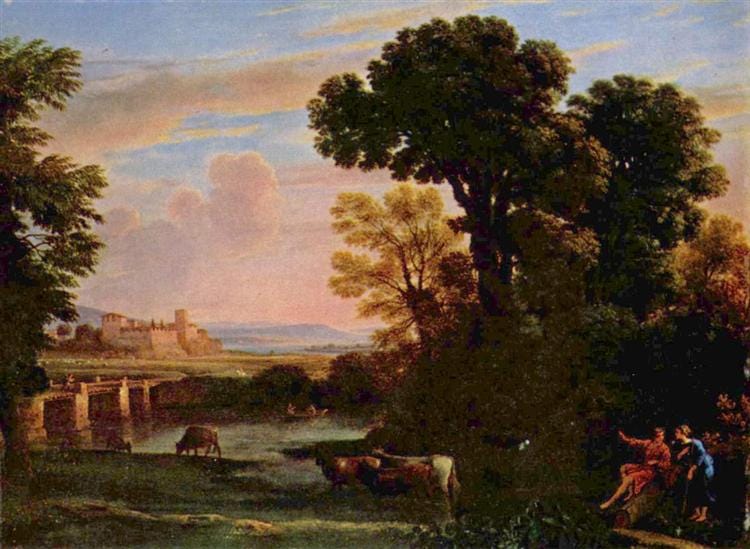
Pastoral Landscape by Claude Lorrain, 1648
It was late Spring in Oddland when the king was about to depart on a diplomatic visit to Upper Pomerania. He was expected to be away until the Fall at the earliest with many expecting it to be much longer than that. In perfect accord with the law of Oddland, no sooner had the King departed from the palace than all members of the castle rushed into the palace courtyard to pass out the royal lots. Everyone from the baker to the butler had dropped their work to appear in this courtyard. This was one of the few activities in Oddland that was done with the utmost solemnity and decorum. While everyone was still coming in, the royal lots were hurriedly brought out. The lots were a set of gold cylinders about the size of a pencil and housed in an opaque silver chalice supported on a pedestal set in the center of the courtyard. The pedestal was made of ivory and no more than three feet tall. The chalice was a rather plain silver chalice with the three words, “Fortuna caeca est,“ engraved on the side. The pedestal, chalice, and lots were arranged and brought out by two men, both of them blindfolded. Once the pedestal had been set, the men turned their back to the chalice, removed their blindfolds, and walked toward one of the walls of the courtyard. With the chalice in place, everyone who worked at the castle, from the stable boy to the Royal Chancellor, queued up in front of the chalice with total solemnity and gravity. The royal members arranged themselves in the queue with perfect propriety so that the gaps between people were of the same distance. There were so many that day that the line soon snaked about the courtyard with an almost mathematical exactitude. It was both rapid and methodical the way in which each person approached the chalice, extracted their lot, and hurried off to the wall of the courtyard where they would stand, back to the wall, clutching their lot with both hands. When all had selected their lot and the chalice was empty, the Royal Chancellor approached the pedestal, raised his eyes, and shouted with a loud voice, “Whosoever has the lot with the blue dot shall be the despot.” The courtyard soon rustled with the noises of people inverting their lot and inspecting the lower face. It didn’t take long before a shrill voice interrupted the noise with a shout,
“It’s me! I’m the despot!”
All eyes turned to look at the speaker. The speaker was a boy who worked in the King’s stable. He was a boy of about 12 named Casimir. Casimir had only been working at the Castle for 3 months, yet that still qualified him to be present at this lottery. No one knew much about Casimir’s history. He was hired by the Stablemaster not because of ability but because of pity. The Stablemaster saw him wandering about the street one day, gaunt and hungry, yet still quite careless. He offered Casimir a job tending the King’s stables and mentioned that there would be plenty of food as none of the King’s workers went hungry. Casimir gladly accepted the offer, though none really knew if he was truly poor or starving. It became clear later that Casimir always looked gaunt and hungry. He also never acted like he was poor or had ever been poor. He seemed more like a vagrant than a vagabond. This led the Stablemaster to wonder if his pity was misplaced. Casimir had never before witnessed this odd ritual, but participated in it with complete calmness and familiarity.
“The despot has been chosen. Long live the King! Long live Casimir!” Shouted the Royal Chancellor.
“Long live the King! Long live Casimir!” Cried those present in the courtyard.
As everyone distilled out of the courtyard to resume their normal jobs, the Royal Chancellor rushed Casimir into the throne room. He placed Casimir on the throne and kneeling before Casimir said,
“King Casimir, your servant Davor is before you. I have faithfully served the King as Royal Chancellor and I will gladly serve you as well. I am at your service, most excellent King Casimir.”
Casimir leaned back and with as royal of an air as he could muster, responded by saying,
“Thank you, Davor. The King is grateful. You may go.”
We’ve all likely imagined what it would be like if we were instantly made ruler of a kingdom. Casimir likely did too for the first few days of his reign consisted of the most childish lavishness. It was a rule by the order of King Casimir that every meal was to consist of fried chicken covered in candy and topped with ice cream. Casimir ordered pictures to be painted on the walls of the stables (he didn’t really care what pictures, he just thought the walls were boring without them). He also had a robe made with the words, “King Casimir, the Great” stitched onto the back. There was no doubt that he was enjoying being king. Unfortunately for Casimir, the enjoyment didn’t last and after the first week, he was irrepressibly bored.
“Davor,” said Casimir while slouched in the throne, “I’ve decided that I want to be an actual king. But more than that, I want to be a popular king. I want to be the most popular king in the world. Do you know how I could do that, Davor?”
“Yes that’s very wise,” said a monotone Davor. “It’s also quite easy to be a popular king. Just lower taxes.”
“Lower taxes? That will make people like me?”
“Of course it will. Tax cuts are always popular whether they’re a good idea or not.”
“That’s a great idea then! But who should I cut taxes on?”
“That is quite simple. Whoever is paying you the most in taxes should have their taxes cut.”
“That’s another great idea! Thank you, Davor, you’re really helpful. Who is paying the most taxes?”
“Currently, the richest people in this country are paying the most taxes.”
“Really? Why is that?”
“You’re too young to understand the full wickedness of men but the barbaric practice of ‘income tax’ makes it so.”
“That’s horrible! I will end it at once! Davor, grab a pen and paper and let me dictate to you an immediate proclamation.”
Thus King Casimir began to end this barbaric practice he had just discovered. Yet it should be noted that Casimir dictated a proclamation to Davor not because of convenience but because it was necessary. You see, Casimir had never learned to read or write. He never saw this as a problem before he was king and now that he was king, he saw it as even less of a problem. Davor was always more than willing to copy whatever Casimir dictated. Yet perhaps he was less “willing” and more “eager.” As King Casimir’s reign continued, Davor began to embellish the dictated proclamations. For example, in this proclamation just dictated by Casimir, Davor embellished it slightly so that only his family would be exempt from all taxes. This was clearly not what Casimir intended, but Davor reasoned that Casimir could hardly care less. For the most part, Davor was right. After the proclamation was made and the law was sealed with the King’s seal, Casimir’s popularity did increase. It especially increased among a certain large and wealthy family. Casimir only noticed the increase in popularity and thus wasn’t suspicious in the slightest. As the months rolled by, however, King Casimir began to see a steady decline in popularity. This did worry Casimir slightly and so he had Davor write more and more laws in the hopes of increasing his popularity. He wrote a law that every household in Oddland was to receive a new coach with the words, “From King Casimir, the Great” painted on the side. He wrote a law that two Wednesdays of every month would be a paid holidays. He ordered pictures to be painted on the sides of all houses so as to “lighten the mood” of all citizens. Yet after all of this, it was clear to Casimir that his popularity wasn’t improving. Once looked out his window and could see people grimace at him whenever they caught a glimpse of his face (he also saw one very happy group of people in a shiny carriage departing from Davor’s estate, which cheered him up slightly). Casimir began to be troubled. He was so troubled that one day he didn’t get out of bed. This was very unusual for Casimir but not very unusual for a King. None of the members of the palace took much notice and simply had meals brought up to him. When it was about dinner time on this day, the cook brought Casimir a dish of his favorite fried chicken and freshly made strawberry ice cream.
“Here you are, your highness,” said the cook warmly. “The royal dish ordered by King Casimir the Great.”
“Oh it’s all a lie!” Shouted a distraught Casimir from underneath a pile of pillows. “I’m not the greatest king! I’m not even the most popular king!”
Up until this point, the cook was simply performing his duty, but hearing Casimir in this state made him worry. Yet this worry soon gave way to another feeling of opportunity and ambition. For you see, Davor was not the only one keen to exploit young Casimir. This cook was not a native Oddlandian. He was a political exile from Upper Pomerania. He had snuck across the border of Oddland and started a new life here, eventually working his way up to the royal kitchen. This cook, whose name was Florien, was a secret revolutionary. He had started an uprising in Upper Pomerania that exiled him and forced him to flee. He was in Oddland waiting an opportunity to return to Upper Pomerania as a stronger revolutionary. Seeing a simple King wanting only to be popular, Florien, the eternal opportunist, seized upon a plan.
“Oh you want to be a popular king?” Said Florien with as much cordiality as he could muster.
“Yes I do!” Said the pouting Casimir. “I want to be the most popular King in the world!”
“Oh is that so? Good! That’s a very noble goal, but you’re going about it all wrong.” Said Florien with the tact of a serpent.
“Really? What am I doing wrong?” Asked Casimir with a hopeful tone.
“You’re trying to make yourself popular with your own citizens! You have to have more citizens. Better yet, you have to free more citizens. You have to find the cruel countries in the world and emancipate their citizens! Make your country bigger and your popularity will be bigger as well. Only then could you be the most popular king in the world. After all, who wouldn’t want to be under such a great King?”
Casimir sat up and peered at Florien from behind his mound of pillows. It was clear that he was thinking the matter over.
“But are you saying I should invade other countries?” Queried Casimir, becoming more comfortable with Florien’s idea with every second.
“No of course not!” Cried Florien. “It’s not invading, it’s freeing. You’re not declaring war, you’re emancipating a people.”
“Oh good!” Said Casimir, his face immediately brightening. “I was worried you were talking about war but that’s not war! That’s just being a good king! That’s an excellent idea. Will you dictate a law for me?”
A grin spread across Florien’s face. “I would be more than happy to, my King.”
Davor was on his way up to the King’s chamber when he met Florien coming out.
“The King has just declared war on Upper Pomerania.” Said Florien as bluntly and spontaneously as he possibly could. Davor froze in place as his jaw plummeted. He instantly turned a ghostly white and began to tremble all over.
“W-w-WHAT did you say!?!” Shrieked Davor in a tone of disbelief and horror.
“He just sealed this order that I dictated for him,” replied Florien frankly. He handed Davor the piece of paper containing a red, royal seal. Davor reached out a pale, trembling hand as he read,
“By order of the Great King Casimir,
The crimes and atrocities of the Kingdoms of Upper Pomerania have come before me. Their leaders are cruel, corrupt, and filled with mischief. Therefore, it is with great fervor that I, the Great King Casimir, will invade, attack, and utterly wipe out the Kingdoms of Upper Pomerania. My General, Florien the Mighty, shall devour you as the lions devour their game. To the end that no tyranny should long live on this earth, I set my sword against you and vow to free your people from the yoke of their government.”
Davor nearly swooned upon reading these words. He shook violently and turned an even whiter shade.
“As you can see, the King has made me his general. I’m on my way to gather the troops and begin the invasion.” Said Florien with morbid calmness and frankness as he grabbed the paper from Davor’s hand. Davor’s eyes locked with Florien’s in a look of rage and horror. He was still trembling all over as he shrieked,
“You raving anarchist! You’ve gone mad! You devil! You.....*gasp*...you’re going to kill us all!”
“Then we all are martyrs for the great cause of anti-tyranny,” shouted Florien over his should as he walked away. Davor collapsed into a pile of trembling limbs.
“Madness! Anarchy! Ruin!” He mumbled to himself as he lie trembling on the floor. After a span of several minutes, Davor was finally calm enough to stand upright and stumble away.
“Flight,” thought Davor to himself. “Flight, that’s the only answer. The law cannot be reversed. This is the end. I must gather my household and flee south. I must do so quickly!” The limping and trembling figure of Davor went through the gate of the palace and then was seen no more.
Casimir was excited about the military procession out of the capital. He rode in one of the new carriages he had given out to the people. It was his favorite type of carriage. He had driven one a few times while he was a stable boy, but now he was a passenger. This carriage was special as it had “King Casimir the Great” stenciled on both sides of it. Florien led the procession out of the capital with Casimir behind him flanked by two cavalry generals. Behind him marched the army of Oddland, the cavalry following up the carriage and the infantry following up the cavalry. The road towards Upper Pomerania involved crossing the mountains forming the northern border. It was at the top that the border of Oddland ended. When Florien the Mighty and his army crossed this border, it would be an official invasion. Oddland would be at war.
Casimir looked out of his carriage. They were a good distance from the capital and he could see the army filling the narrow road for miles downward. He assumed the army had accompanied as a formality. Florien had assured him it wasn’t an invasion so he didn’t give it another thought. He was too busy observing the road. He enjoyed the view. Since it was officially summer, the weather was a crisp warmness common to the mountains. He saw Florien ahead of him, riding his horse at a fairly rapid trot. The road and sky framed Florien in a most aesthetic manner. He also heard the birds chirping and the grass quivering in the wind. He was not prone to sensitive moments, but at this moment, he was illimitably pleased and sensitive.
“I’m going to be a good king and make people as free as those birds.” He thought to himself with a smile. They had nearly reached the top and he was able to see the plain on the other side. He was quite deep in his freedom meditation when he was interrupted by the thunder of Florien’s horse as it sped by him. Florien had a panicked look on his face as he raced by Casimir back in the direction of the capital.
“Where are you going?” Shouted Casimir, but Florien was already too far away to hear him. “General, please go and bring him back to me. I can’t imagine why he’s heading back.” The general on his right nodded and with a whistle, detached his cavalry regiment to go over take Florien. Casimir looked back over his carriage and squinted after them. He saw that they eventually did over take him and that Florien appeared to be arguing over the demand to return. Eventually, the cavalry officers surrounded Florien and he had no choice but to return back to Casimir.
“I wonder why he was trying to get away,” mused Casimir to himself as he sat back down in his carriage. As he sat down, he looked up and saw another entourage approaching them. The entourage was led by a tall man in a purple cape. Both entourages had come the top of the hill. A border marker stood between Casimir’s army and this other entourage. The man at the front of the entourage Casimir knew immediately. It was the King returning from Upper Pomerania. Casimir was truly glad to see the King and was sure he would take over this emancipation crusade. However, as soon as this tall man crossed the border into his own Kingdom, Casimir forgot that he was no longer King Casimir the Great. The general on Casimir’s left bowed as the King approached the carriage. He stopped a bit, with a look of confusion as he saw the army stretching down the road, the title on Casimir’s carriage, and the now pale faced Florien coming up the road surrounded by cavalry officers.
“What is the meaning of this? Are we at war?” He said, looking down into the Casimir’s carriage. His tone was one of anger, but Casimir didn’t feel he was angry at him.
“Oh no of course not!” Replied Casimir, happily. “We’re not fighting, we’re freeing. We’re going to set people free so that they could see that I’m the greatest Ki-” Casimir stopped short as he stared into the face of the King. The King’s face softened a bit as he said,
“I see. And who told you this?”
“It was the loyal cook!” Answered Casimir with a carefree air. “He was the one who proposed this magnificent mission! I was so grateful I made him in charge of it!” At these words, Florien turned a deathly white and began to tremble. Before Casimir could understand what was happening, a tent had been setup on the Oddlandian side of the border and he was seated, next to a bound and trembling Florien, while the King slowly but furiously wrote the following proclamation,
“To the Kings of Upper Pomerania,
The people of Upper Pomerania have always been our allies and the kingdoms have always been our brothers. My Kingdom seeks only peace and cordiality between our two nations. However, recent reports regarding an invasion of your nations by my nation may have reached you. Because the proclamation were made and sealed with the King’s seal, it cannot be revoked. There will still be an invasion of Upper Pomerania. However, the invading army will be led by ‘Florien the Mighty.’ He alone will be invading Upper Pomerania. I believe you will find him to be thorn about which we spoke during conference. This revolutionary that has been causing trouble in your kingdoms has come down to me and now I ‘return’ him to you as my invading party. Do with him as you see fit.”
And as the proclamation from the King ends so does our tale. Poor Florien was taken captive the instant he “invaded” Upper Pomerania and he was never seen again. Casimir, as is the custom in Oddland, went back to his post as stable boy. He enjoyed his job more now that there were pictures on the wall. The King also ordered Casimir to be supplied with a dish of chicken and ice cream once every month in addition to the food normally given to the King’s workers. And with these final partings, our story of this odd little country comes to a close.