

Protein crystallography is a very old technique with methodology going back 100 years. It’s also very complicated and often unintuitive. It’s not obvious to basically anyone how you go from this:
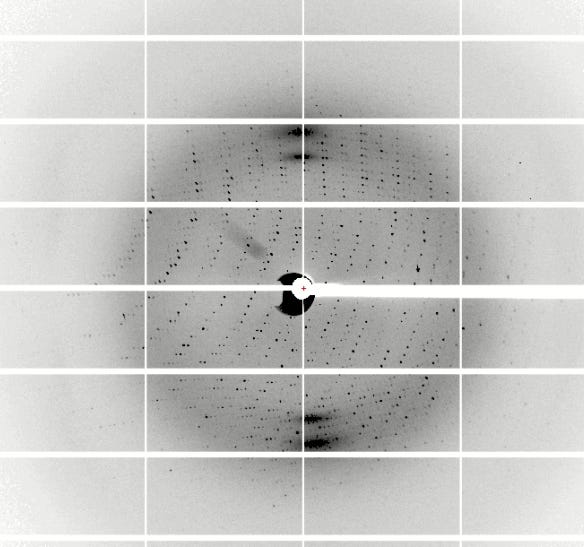
To this:
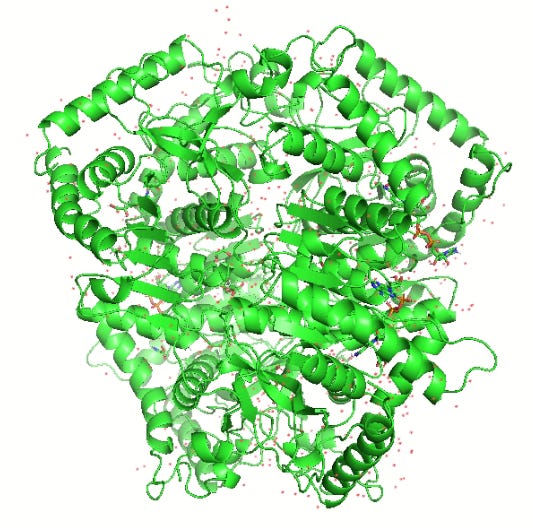
Those who understand the process, both the foundational mathematics and the software doing the math, are counted as “wizards” in their own niche field. Crystallography is built on the slow, rigorous progress of many brilliant minds over centuries. Understanding crystallography isn’t easy, even for motivated initiates.
I am a protein crystallographer (in training) and I knew this about crystallography well before I started. I knew about thick books of symmetry tables, FORTRAN code written in the 80s, and a small taste of the foundational mathematics known as group theory. I get why it is hard. I get why the older generation of crystallographers are considered to be “wizards”. I understand the decades of study needed to fully master this field, and it’s why I joined an email forum of established protein crystallographers from around the world, a place where you could ask questions and share knowledge.
Why is all this important? Because I am not a financial analyst. I am not someone who has any background whatsoever when it comes to market trends, finance, or the motions of money past a CD or IRA. I am a crystallographer. I do crystallography. I consult crystallographers on crystallographic things.
One day, I was reading the crystallographer’s email forum on some obscure problem in crystallography related to someone’s protein crystals. All these big names were addressing this problem. People from Harvard and European Synchrotrons were answering a question. Yet among all the answers, from the big shots and the “wizards”, there was a paragraph written by the infinitely prolific ChatGPT. Someone, one of these big wigs, had asked ChatGPT the crystallographer’s question and it had spit out an answer. And the answer, surprisingly, was quite good.
I will reiterate, I am not a financial analyst. I don’t know how to properly value companies. I am familiar with the proverb, “when your taxi driver is talking about stocks, it means it’s overvalued.” What I am positing is that, while that may certainly be true, the converse could also be true. Everyone has seen the news talking about the overvaluation of OpenAI. Everyone has seen people talking about the bubble mechanics of AI. There have been endless articles written about AI overuse, philosophical problems, and the danger it poses to creative arts. But has anyone stopped using it? Will my crystallographers stop using it? Will I stop using it?
I asked ChatGPT to make me a workout plan. I then asked it to turn that into a PDF for me. It said it couldn’t turn it into a PDF, but it did give me python code that would generate it for me. I wasn’t signed in. I didn’t pay a dime for that. But in two queries it was doing the work of Google, Youtube, VSCode, and even Adobe. A single tool is functioning as a search engine, coach, IDE, and even PDF manipulator (I would love it if ChatGPT replaced Adobe Acrobat). The giants of 2010s tech are being surpassed by a single tool. That just might mean it really is worth the hype after all
My thesis is really simple, people are using LLMs more than they realize to the point where it will soon become a bedrock technology. Because of this, OpenAI may end up being worth more than we realize. If you’re still skeptical about my thesis, just go out and observe people. Observe yourself. Do you see people using it? Are you using it? Does it seem like the the headlines are matching up with daily use? In my opinion, it isn’t. And in this particular instance, I will trust the daily use over the headlines.
I’m not saying any of this is a good thing. I don’t know if it is. I am just saying AI use has even gotten to me, in a field notoriously impenetrable and hard to understand. What does this mean for the future? I don’t know. Maybe I’ll ask ChatGPT.
Some of us have simply never used it, and will go on refusing to. Possibly more than you think, because they're not often obnoxiously loud about it the way tech guys often are.