

In a way, libertarianism is a noble aim. Nay, idyllic: the idea that all men should have the right to govern their own lives, that government may do nothing (or as little as possible) that interferes with your agency to make your own choices. It is an inherent optimism to hold that an ideal society needs no ruler, no bureaucracy to hold the individual in check; that man at his best is man on his own. And libertarianism seems to follow naturally from the fundamentals of classical liberalism. Liberalism was a colossal achievement on the world stage, and much of it stemmed from the foundational belief that (so far as is possible) man should be allowed to govern himself, rather than withstand the whims of whatever despot held the throne.
This was a problem for despots, as their entire business was bossing people around for their own benefit. History has definitively shown that a nation’s best route to prosperity is rarely to sail the stormy sea of a single man’s whimsy. When permitted to act in their own interests, men unfailingly do so. When a society is allowed to choose actions that benefit themselves (rather than just those in command) the result is economic growth and societal stability. Logically: when each benefits, the whole benefits (although this does not necessarily mean all benefit). All this is widely accepted free-market dogma.
But libertarianism has one nagging problem. No matter how free your society is, that freedom will never make your society good. Man’s default is to benefit himself, as just said, but that does not mean his default is to be virtuous. In fact, the two are contradictory: no matter your moral groundwork, it’s a pretty dismal code of ethics to argue virtue is self-service. Most are quite the opposite: virtue (according to most interpretations, including the correct one) involves being good to others, something we are not good at. Libertarianism’s entire philosophy is that it can’t (or won’t) make you, the citizen, be good, and that if you’re going to be good, you’re going to have to choose it yourself. You can even choose to be bad. (Is that, for some, an allure, rather than a drawback? We may never know.)
Let’s consider three separate-but-related issues: recreational marijuana, alcohol usage, and sports gambling. In the past few years, here in the US, both marijuana and sports betting have largely gone from illegal to legal (one hundred years ago, alcohol did the same). The policy reasoning was fairly straightforward: you, an individual, might believe that any one of these activities is bad or harmful, but somebody else might disagree, wishing to pursue them. Since all of these are personal activities that don’t affect other people, why should the government be the one making value judgments for you? (This is better known as the “harm principle”; that the only reason a state may justly override a citizen’s will is to prevent harm to other people.) What right has the state to tell you what is right and what is wrong? (Ostensibly. Certainly, in the cases of marijuana and gambling, well-endowed lobbying played an equal role.)
On the surface, all of that sounds great, and I don’t mean to discredit these arguments at all. This line of argument (whether or not government should be making value judgments for its citizens) is legitimate and worth consideration. The answer, as we’re about to discuss, is sometimes ‘yes’, but there is real danger in allowing the state to overreach its bounds. In fact, the mindset of “libertarian until proven otherwise” is not the worst rubric with which to approach policy questions.
But when we apply a strictly libertarian/ liberal framework to these three issues, we start to get unpleasant results. There were good arguments for marijuana usage to be legal, beginning with the most pragmatic: functionally, it already was. It feels bad to be giving people felonies for what feels like relatively common and minor offenses, which is the point that weed usage had breached. Pot smoking isn’t connected with the violent crimes and abuse that drunkenness too often is, etc; the majority of the time, it didn’t affect anyone other than the smoker. Even if it has deleterious long-term physical effects, so does smoking (which is legal). So does drinking (which is legal). So does office work (to a lesser extent).
By 2023, this view (that marijuana use should be legal) was shared by an overwhelming majority of the US population (70%, according to Gallup). But then, something odd happened. As more and more states began to legalize marijuana, its support noticeably declined, after rising almost uninterrupted for three decades.
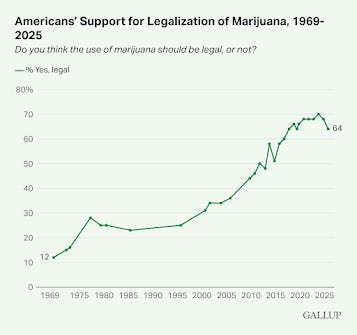
Weed legalization was, by all accounts, the clear majority position, yet upon its introduction, the people started to regret it. Something being popular does not make it good. Something being legal does not make it good. And it turns out that the idea of marijuana being legal is a little more appealing than the reality.
There are several reasons for this, both related and unrelated.1 I’m not here to argue that marijuana should go back to being criminalized. I believe, unfortunately, that there are many good arguments on both sides. I’ll just make the very broad point that most weed use is bad for you, legalizing weed means we have more weed users, and a society full of stoners is now a worse-off society. That’s what we’re here to demonstrate: more freedom made society worse.
The sports gambling epidemic is a similar story. Americans wagered nearly $170 billion on sports in 2025, and casinos took home about 10% - a delicious profit margin. (Don’t worry, it all went to make delightful commercials.) Again, this is an issue that affects only the user; what right have I or anyone else to forbid young men from throwing their money away, if that’s their preferred mode of entertainment? At the same time, should we, the responsible citizens, watch stoically as our fellow men throw so much of their futures and livelihoods away? While the urge that somebody ought to do something about that is not necessarily a conservative one, I’m not here to tell you it’s a bad one.2 Again, in this instance, this freedom made society worse.
That is why you shouldn’t be libertarian. But I bring up alcohol as a counter-example. Upon reflection, alcohol seems to have a much more scurrilous effect on society. In the US, over ten thousand people die in drunk driving accidents every year. The correlation between alcohol usage and domestic violence is extremely strong. In short, the negative effects of alcohol’s legality are undeniably worse than the effects of either marijuana or gambling. So why is banning alcohol not in the same converation? Think of the lives spared on the highways, or the family lives repaired by a return to sobriety.
You can point to alcohol’s alleged positive effects (“lubricating the cogs of society” or whatever euphemism you prefer for the fact that sober people … don’t like each other as much.) Additionally, you can point to the fact that once upon a time, we famously did exactly this. The Eighteenth Amendment did prohibit the sale of alcohol, and all of society’s ills magically, instantly, disappeared.3 If only. Rather, the underworld alcohol trade instantly stepped up to meet the unquenched demand. Bootlegging gangs ran rampant in the streets of New York and Chicago, as Prohibition effectively kickstarted the mob in the United States. Violent crime and corrupt officials abounded. Horrified, the nation discovered “second-order effects”.
So while the freedom we’ve received regarding marijuana and gambling may well make society worse, we can’t assume that the prohibition would have the opposite effect. Sometimes, prohibitions make society even more worse. Because the problem we’re discussing isn’t a problem of law. It’s a problem of man. And while this problem is most clearly illustrated by libertarianism (or would be, real libertarianism has never been tried), it underlies any political system, and indeed human life itself. Societies and governments that ignore man’s flaws are in for a rude awakening. Because it’s not a political philosophy problem, it’s a human problem: the fact that humans are doomed to imperfection and certain to make poor decisions. All of them! You’ll recall that the worst (maybe not the worst) thing about tyranny is that you have no control over who gets to make the bad decisions. But even when you do have control, bad decisions are still going to be made. Men still want to gamble and drink and smoke and do drugs and cheat and steal. And because they want to, they will, as long as they can get away with it. This problem is not unique to liberalism. In short, if freedom is good, why are free people still bad? Freedom was never supposed to make you good. But freedom at least gives you the opportunity.
A couple points of meta-commentary before we conclude. First, the American Constitution is not a libertarian document. It establishes rules for government and rights that that government may not infringe. But outside of those fundamental rights, we can make whatever laws we want. Drinking and gambling are not expressions of your first amendment rights. It is just as Constitutional for Utah to ban sports gambling as it is for Florida to permit it. Both of those are well within the bounds of the age-old American question: how shall we govern ourselves? If it sometimes feels like there’s no right answer, that’s probably correct: either side is going to come with benefits and downsides, tradeoffs that must be considered, not denied. That, in a nutshell, is governance.
Second, a possible solution from the policy wonks (to whose ranks I aspire) is that, instead of prohibiting, we heavily tax the vices (drinking, gambling, drugs, etc). Ideally, this would have a triple benefit: allowing and regulating such behavior (as opposed to a black market), while economically discouraging it, all while counterbalancing the negative effects with added revenue for state and local governments. Yes, this would potentially encourage a cheaper black market to offer the same sins at a lower price, but it seems like a compelling compromise.
Finally, if you are to come away from this article with anything, remember these two points. First, man is imperfect (depraved, even). No system that relies on man can ever achieve perfect results. (It’s cliché at this point, but correct, that if men were angels no government would be necessary.) But second, man’s imperfection is not, in fact, another convenient proof that your pet theory to solve civilization is actually correct, even if it’s easy to point to as proof that the status quo is not working. Bad things happen under liberalism. Bad things happen under tyranny. Bad things happen under communism. Man’s imperfection is a constant. A constant that can be (must be) dealt with in any number of ways, but not denied and not ignored. The goal of a system of government cannot be to prevent everything bad from happening. That’s unrealistic and impossible, and is thus an unfair and unhelpful measure of what we want out of our government. Even a good government can’t prevent you from being evil. But a good government can protect your opportunities live an upright, virtuous life. And how else, I ask, will you prove yourself worthy of freedom?
I expect that much of marijuana’s cool factor was due to its clandestine and illicit status (same as smoking). Generally, the risk-takers among us are the people we wish to imitate. But when that is removed, you have ceased to be a rebellious teenager and are now just an unemployed twenty-five-year-old pothead.
Be careful. You’re on the verge of becoming the turbovillain in your future HOA.
Writing from my twenty-first century perspective, a time when getting effective legislation through any part of the government seems impossible, I marvel at the fact that the Eighteenth passed with 68% in the House and 76% of the Senate, and was subsequently ratified by forty-six of the forty-eight states. Truly the temperance ladies were a monumental political force.